

For years, Google and Bing have dominated the search engine landscape, holding a commanding grip on the market. Together, they control over 90% of the market share worldwide, with Google boasting around 90% and Bing close to 4% according to recent data. While AI-powered search engines like Perplexity and ChatGPT are emerging, the established giants still dictate search results for most users.
But what if you’re seeking an alternative, one that values your privacy and doesn’t track your every click? Fortunately, several European search engines offer viable options. Each brings a unique approach, with its own strengths and weaknesses. Some even support impactful causes, from environmental protection to social initiatives.
This article dives into six of these alternatives, hailing from France, Germany, Switzerland, and the United Kingdom. Discover how you can search the web without relying on the American tech giants.

1. Qwant: The French Search Engine Championing Privacy
Launched in France in 2013, Qwant distinguishes itself as a privacy-focused search engine. It refrains from tracking your searches, selling your data, or personalizing results. Everyone sees the same information, regardless of their browsing history.

While initially leveraging Bing’s API, Qwant is steadily moving towards independence. In collaboration with Ecosia, Qwant co-founded European Search Perspective, launching Staan, an entirely European-based platform. This platform hosts its own search index, currently focused on French language queries.
Qwant’s interface has also evolved, offering a modern, customizable experience. Users can choose light or dark themes, filter adult content, and open links in new tabs. An experimental “Qwant Next” tab allows early access to new features.
Qwant provides helpful tools such as “Réponse Flash,” an AI-powered answer box using ChatGPT (GPT-3.5) to directly answer your questions, and an automatic webpage summarization feature. These functionalities are accessible for free after creating an account.
Available on the web, via mobile apps (Android and iOS), and as browser extensions for Firefox, Chrome, Edge, and Safari, Qwant is readily accessible.
Qwant’s acquisition of the meta-search engine Lilo in May 2025 broadens its index while maintaining its ethical principles. Qwant Junior provides a secure environment for children (6-12 years old), free of inappropriate content and data collection.
While Qwant features advertisements, it emphasizes a less intrusive approach. Ads are visible without being overbearing, and personal targeting is absent.
2. Ecosia: The German Search Engine Planting Trees
Ecosia, a German meta-search engine established in 2009, differentiates itself by using advertising revenue to fund climate action projects, primarily tree planting. By May 2025, Ecosia had planted over 234 million trees in over 35 countries.

Ecosia formerly relied on Bing’s and, in some cases, Google’s APIs for search results. However, the engine is now incorporating a European index developed in partnership with Qwant. This new index, hosted on the Staan infrastructure, is currently being rolled out. It is first applied to French language searches, with German and other European languages to follow by the end of the year.
The goal is to reduce reliance on American tech giants while offering an alternative aligned with European values and privacy respect. Ecosia is still a meta-search engine and does not yet have a fully independent index, but it is on its way.
Ecosia publishes a detailed financial report each month. In May 2025, over €3.5 million was generated, with the majority allocated to reforestation projects. These are often managed locally and monitored over the long term. Additionally, Ecosia’s technical infrastructure is powered by renewable energy via solar panels.
Ecosia is available on the web, as a mobile app (Android and iOS), and can be set as the default search engine in most browsers.
3. Lilo: The French Search Engine for a Cause
Lilo, a French search engine launched in 2015, operates on a simple principle: each search earns you a virtual “drop of water.” You can then donate these drops to a social, environmental, or charitable project of your choice. Since its inception, Lilo has donated over €5 million to hundreds of organizations.

Lilo utilizes Bing’s search results and other sources like Yahoo, Pages Jaunes, and even Google (via a secondary tab). Its aim is to provide a standard search experience while directing a portion of its advertising revenue to user-selected projects.
Lilo respects your privacy, refraining from selling your personal data or tracking your searches. Statistical tracking is optional and easily disabled.
The search engine is available on the web, through mobile apps for Android and iOS, and as browser extensions for Chrome, Firefox, Edge, Safari, and Opera.
Acquired by Qwant in May 2025, Lilo remains active with its charitable model intact. This partnership aims to share technologies and enhance an independent European search index. It may also allow Lilo to gradually detach from American APIs.
Besides funding projects, Lilo is committed to carbon neutrality. The company finances a program for ecological stoves in Malawi to combat deforestation while improving local living conditions.
4. Startpage: The Privacy-Focused Search Engine Based in the Netherlands
Startpage, launched in the Netherlands in 2006, distinguishes itself by delivering Google search results without tracking you, storing your searches, or creating user profiles.
Startpage acts as an intermediary. It submits your query to Google, retrieves the results, and displays them to you without sharing your data. Even your IP address is removed before processing. No information is recorded, including your search history.

The engine does not use tracking cookies. It displays advertisements based solely on search keywords, without behavioral targeting. This allows Startpage to remain free while protecting your privacy.
An interesting feature is the anonymous mode, which allows you to visit linked websites without being recognized. This integrated proxy is activated with a single click, next to each link.
The interface is simple, fast, and accessible via a browser extension. Startpage also offers a mobile app (Android and iOS) and can be set as your default search engine.
Based in the Netherlands, Startpage is subject to GDPR, further reinforcing its commitment to privacy. Unlike other search engines, it does not aim to diversify or offer additional features, but focuses on providing relevant results without profiling users.
5. Swisscows: The Swiss Search Engine That Prioritizes Privacy and Safety
Swisscows, launched in 2014 by the Swiss company Hulbee AG, is a search engine based in Egnach, Switzerland. It emphasizes privacy with no data collection, no tracking, and, crucially, no inappropriate content in search results. It is one of the few search engines that explicitly caters to families.

Swisscows does not track users. It stores no IP addresses, history, or cookies. No profiles are created. Advertisements are not targeted, but based solely on the keywords entered. To ensure complete confidentiality, all traffic passes through servers hosted exclusively in Switzerland.
Swisscows uses its own index enriched with in-house semantic technologies. Since 2025, it has incorporated data from Bing and Brave Search while maintaining its privacy-focused approach. Queries are analyzed contextually, providing relevant results even without user tracking.
By default, Swisscows filters out pornographic or violent content. This feature is especially beneficial for use by children or in educational settings. The interface is user-friendly and available in multiple languages.
Swisscows also offers privacy-focused services such as a VPN, an encrypted messaging service called TeleGuard, and a secure email solution (Swisscows.email). The company also develops tools like GetDigest, an automatic content summarization system, and an internal search engine for businesses.
Swisscows caters to those seeking a serious alternative to Google, offering no tracking, a family-friendly approach, and a solid technical foundation. While results may sometimes be less extensive than on traditional search engines, the overall experience is cohesive.
6. Mojeek: The Independent UK Search Engine That Doesn’t Track You
Mojeek is a British search engine that has made a radical choice: to rely on no other company for its search results. No Bing, no Google, no third-party APIs. Mojeek relies entirely on its own index, fed by its MojeekBot, and an in-house ranking algorithm. As a result, the displayed results often differ significantly from those found elsewhere.
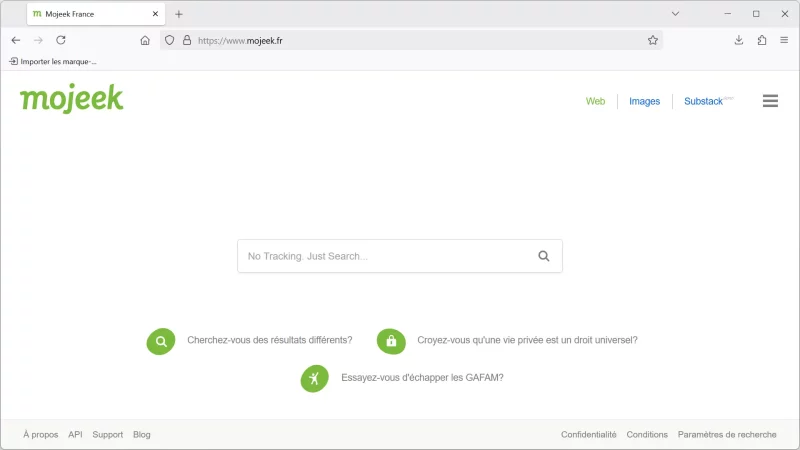
Launched in 2006 and based in the UK, Mojeek places privacy at its core. No personal data is recorded, and no tracking is performed. No cookies, no advertising profiles, no targeting. The results are identical for everyone, provided they have the same regional settings.
Unlike other search engines that repackage data from Bing or Google, Mojeek indexes the web itself, without trying to emulate the giants. It presents itself as a genuine alternative with an ethical vision of the web. The interface is simple, fast, translated into several languages, and customizable. You can even disable Wikipedia snippets in search results.
Mojeek also offers unique features, such as searching by emotion (yes, really) and the “Mojeek Focus” system, which allows you to create sets of sites to explore as a priority. The search engine can be used on the web, added as the default search engine in your browser, or installed via its mobile app (Android and iOS).
Finally, its servers are hosted in one of the most environmentally friendly data centers in the UK, which should appeal to those seeking a search engine that respects both privacy and the environment.
Comparing European Search Engines: A Summary Table
To provide a clearer overview, here’s a comparative table summarizing the search engines discussed in this article, including their country of origin, their use of a proprietary index, their dependence on other search engines, their approach to privacy, and their advertising model.
| Engine | Country | Own Index | Dependence | Privacy | Advertising |
|---|---|---|---|---|---|
| Qwant | France | Partially (EUSP) | Bing | Yes | Yes (non-targeted) |
| Ecosia | Germany | Partially (EUSP) | Bing & Google | Yes | Yes (non-targeted) |
| Lilo | France | No | Bing & Google | Yes | Yes (non-targeted) |
| Startpage | Netherlands | No | Yes | Yes (non-targeted) | |
| Swisscows | Switzerland | Partial | Bing & Brave Search | Yes | Yes (non-targeted) |
| Mojeek | UK | Yes | No | Yes | No (or very little) |
Conclusion
As demonstrated, numerous credible alternatives to Google and Bing exist, allowing you to search online without sacrificing your privacy. Some support ethical projects, others prioritize an independent index or complete tracking absence.
Each solution offers its strengths. Consider what matters most: privacy, environmental commitment, or technological independence. Nothing prevents you from testing several before choosing the one that best fits your needs. The power of choice is now in your hands!
Add Tech2Geek as a preferred source on Google to see more of our latest tech articles.
Support Tech2Geek ❤️
Did this guide help you? If Tech2Geek saves you time or helps you solve a problem,
consider buying me a coffee. ☕
Your support helps keep Tech2Geek independent and free.
Hi
Great article and very informative.
One thing I’ve discovered is that Start page is owned by an American company