

Choosing between intrusive logging and leaving users in the dark is a classic dilemma for JavaScript developers. Do you burden your users with unnecessary dependencies for debugging, or do you forgo vital information when things go wrong?
Enter LogTape, a modern JavaScript/TypeScript logging library designed to solve this age-old problem with elegance and efficiency. This innovative approach allows you to gain powerful logging capabilities without impacting your users until they choose to utilize them.
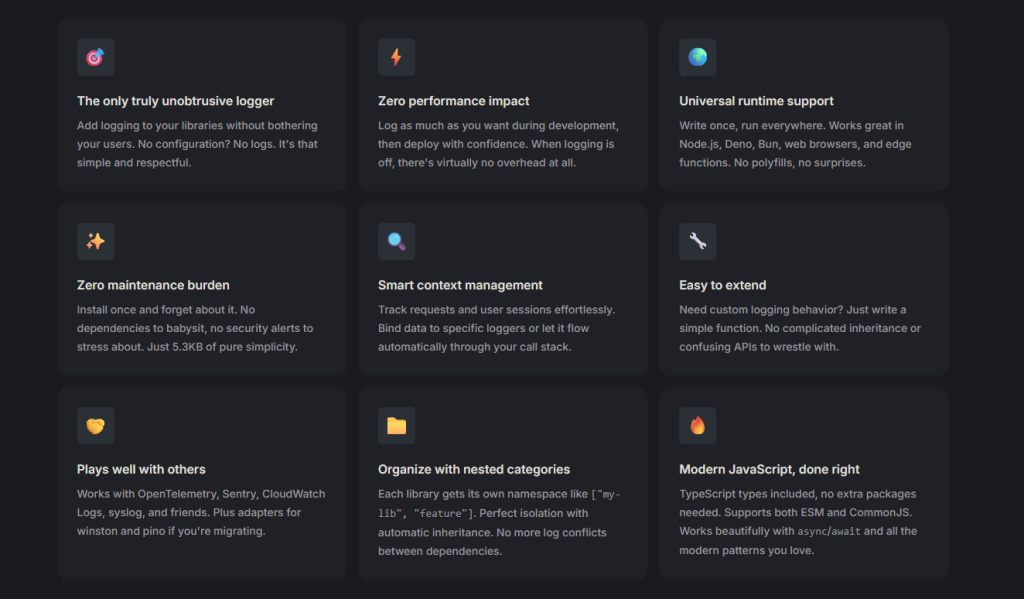
LogTape’s lightweight design (only 5.3KB minified and gzipped) champions a “library-first” philosophy. It boasts zero dependencies, ensuring your logs remain completely silent until the end-user configures them. This approach is excellent for privacy and prevents the clutter of unwanted console messages.
The creator of LogTape, Dahlia (Hong Minhee), recognized a need for a versatile solution in the JavaScript ecosystem. LogTape delivers impressive cross-platform compatibility, running seamlessly in Node.js, Deno, Bun, web browsers, and even edge functions. Its single API and unified codebase ensure consistent behavior across all environments. LogTape offers hierarchical categories, enabling you to organize logs by modules, submodules, and specific features. This allows you to selectively enable logging for your authentication module in production to track down a bug, without being overwhelmed by logs from other parts of your application.
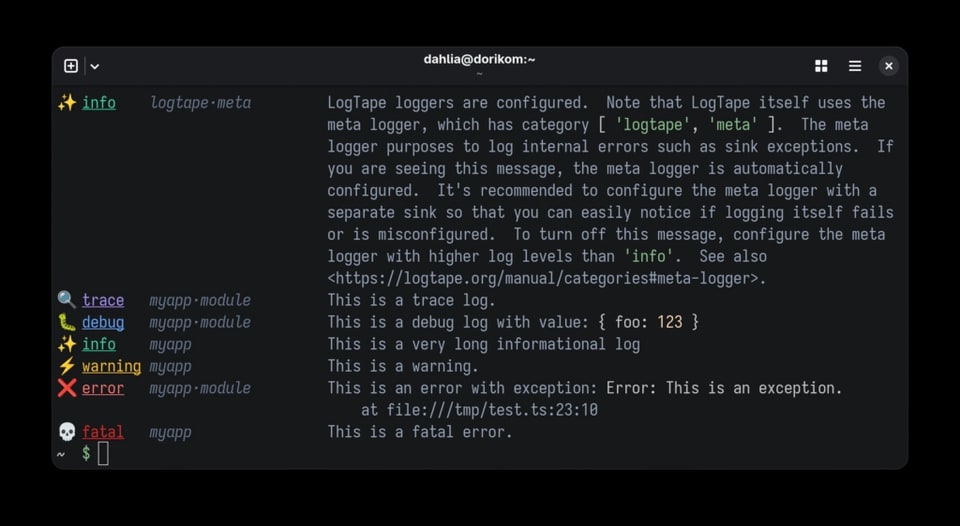
Leveraging JavaScript’s template literals, LogTape creates natural-looking log messages with placeholders. Avoid tedious string concatenation and manual object formatting. Simply write logger.info\User ${userId} logged in at ${timestamp}\“, and LogTape handles the rest. For sensitive data, the library includes an automatic redaction system to mask confidential information, keeping your user’s data safe.
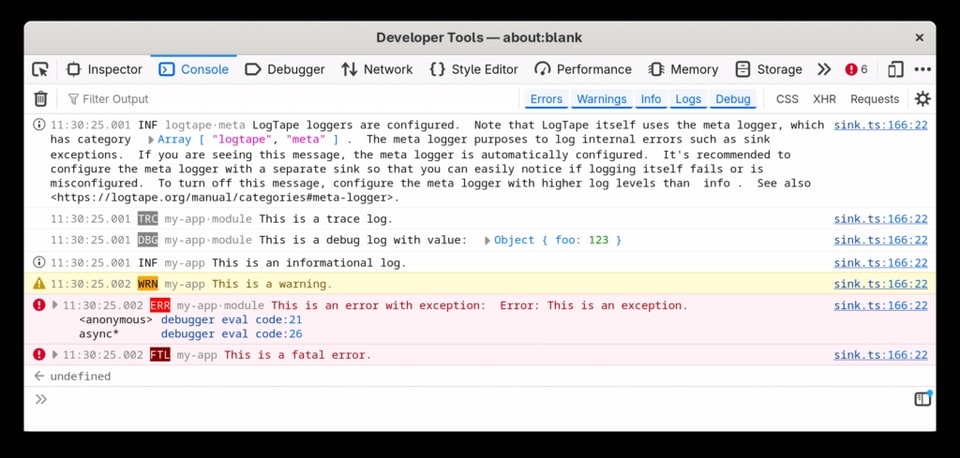
Performance is a core consideration in LogTape’s architecture. Non-blocking sinks with an asynchronous buffer system ensure your logs never impact your application’s performance, even with extensive logging. Lazy evaluation only executes expensive calculations if the corresponding log level is active. This allows you to implement extremely detailed debug logs without performance concerns in production.
For developers already using existing logging infrastructures, LogTape offers adapters for Winston and Pino, facilitating a smooth migration. Moreover, the ecosystem is rapidly expanding with features such as sinks for AWS CloudWatch, Windows Event Log, pretty printing for development, and OpenTelemetry support.
Here’s a basic example demonstrating the system’s power:
await configure({
  sinks: {
    console: getConsoleSink(),
    file: getFileSink("app.log"),
  },
  loggers: [
    { category: "my-app", lowestLevel: "debug", sinks: ["console"] },
    { category: ["my-app", "database"], lowestLevel: "info", sinks: ["file"] },
  ],
});
The recently released 1.0.0 version guarantees API stability, which is reassuring for production adoption. With features like structured logging (perfect for cloud environments), the ability to add contextual data to all logs, and an extensible filtering system, LogTape demonstrates a mature approach despite its recent debut.
Ready to get started? Installation is straightforward: npm install logtape.
With clear documentation, ample examples, and a growing community creating plugins and extensions, LogTape brings a fresh perspective to JavaScript logging. While libraries like Winston, Pino, and Bunyan exist, LogTape stands out with its library-first approach and zero-impact philosophy.
And if you'd like to go a step further in supporting us, you can treat us to a virtual coffee ☕️. Thank you for your support ❤️!

We do not support or promote any form of piracy, copyright infringement, or illegal use of software, video content, or digital resources.
Any mention of third-party sites, tools, or platforms is purely for informational purposes. It is the responsibility of each reader to comply with the laws in their country, as well as the terms of use of the services mentioned.
We strongly encourage the use of legal, open-source, or official solutions in a responsible manner.
Comments