

A new version of AMD’s upscaling technology may be closer than expected. Recently, a leaked DLL file believed to contain an early build of AMD FidelityFX Super Resolution 4.1 surfaced online.

The file reportedly originates from AMD’s Vanguard beta testing program, though its exact source hasn’t been officially confirmed.
What we do know is that replacing the existing driver file allows certain games to run FSR 4.1 instead of FSR 4.0.3, offering a glimpse at how the next iteration of AMD’s upscaler might perform before its official announcement.
Some games even display the active FSR version number, including Marvel’s Spider-Man 2 and Kingdom Come: Deliverance II, confirming that the leaked file is indeed functioning.
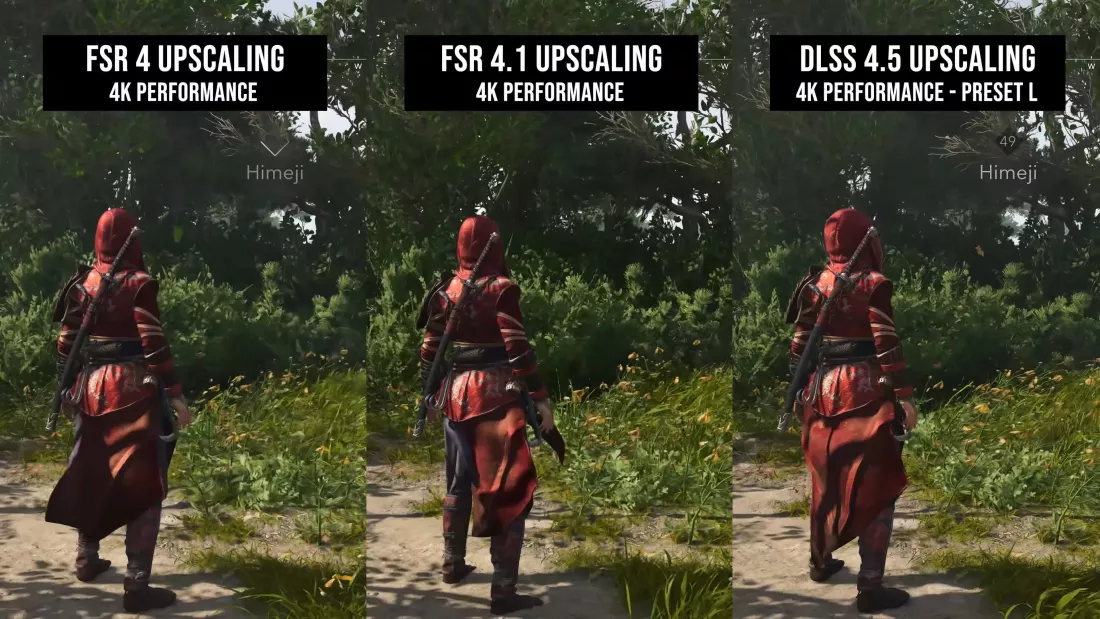
The Context: FSR vs DLSS
When FSR 4 launched about a year ago, it represented a major leap forward for AMD’s image reconstruction technology.
However, Nvidia maintained a clear advantage with Nvidia DLSS, especially with the release of DLSS 4.5 earlier in 2026.
DLSS 4.5 introduced a second-generation transformer model that significantly improved image sharpness and stability.
That raised expectations for AMD’s next move. FSR 4.1 appears to be AMD’s response.
FSR 4.1 Improves Detail Reconstruction
Testing the leaked build shows that FSR 4.1 focuses primarily on improving detail reconstruction, particularly in motion.
Compared with FSR 4:
- Images appear less blurry during movement
- Fine textures retain more detail
- Overall clarity is slightly improved
For example, in Cyberpunk 2077, paused gameplay reveals noticeable improvements.
Road textures and vehicle surfaces appear clearer with FSR 4.1 than with FSR 4, although DLSS 4.5 still produces the sharpest image overall.
The difference is especially visible when using 4K Performance mode, which was the primary testing configuration.
However, improvements vary depending on the game. In Horizon Zero Dawn Remastered, visual differences between FSR 4 and FSR 4.1 are minimal.
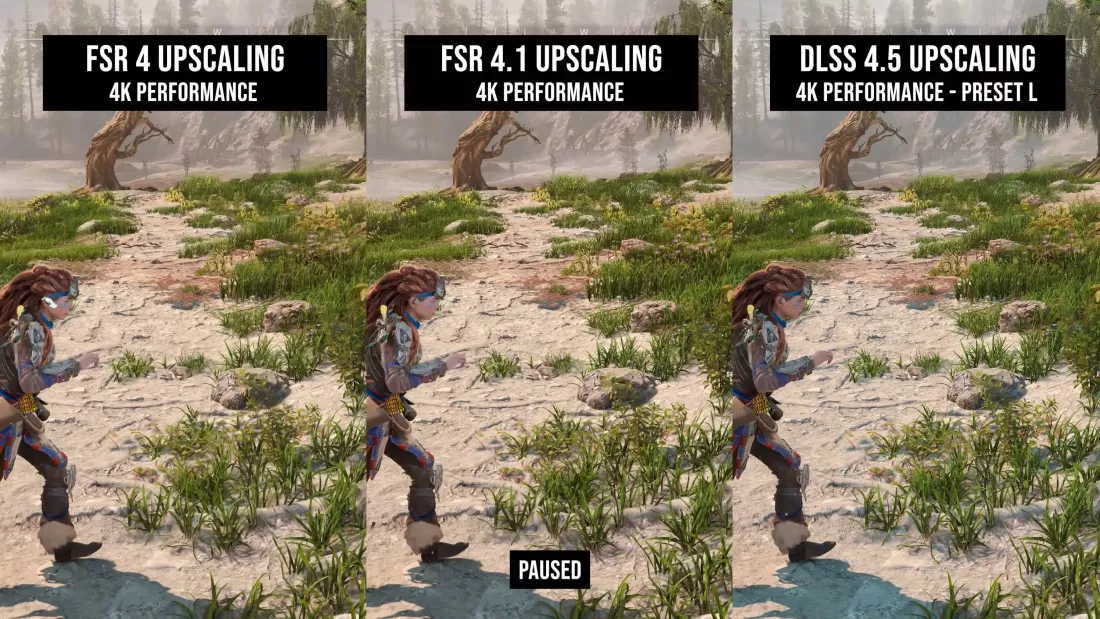
Major Improvement: Less Smearing in Foliage
One of the biggest weaknesses of earlier FSR versions was smearing in complex scenes, especially those with dense vegetation.
Games with lots of grass or tree detail often exposed this limitation.
FSR 4.1 significantly improves this behavior.
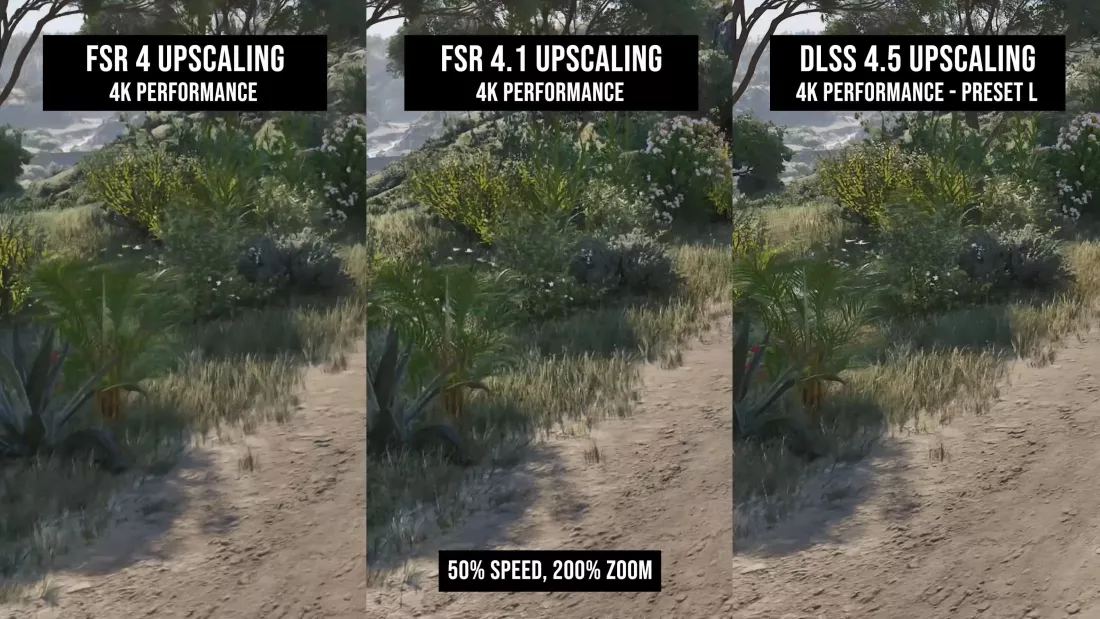
In Star Wars Outlaws, overlapping grass and shrubs appear more detailed and less blurred when the camera moves.
Similar improvements were observed in:
- Mafia: The Old Country
- Assassin’s Creed Shadows
- S.T.A.L.K.E.R. 2
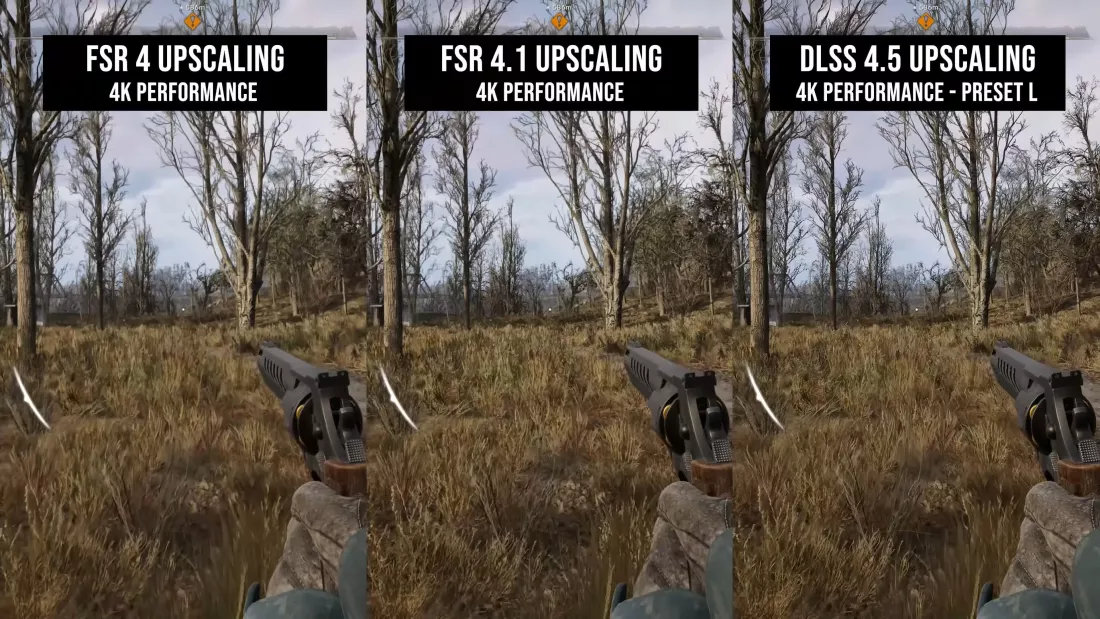
In these titles, grass and foliage retain more structure during movement, making the image feel closer to native resolution.
In some cases, FSR 4.1 even rivals DLSS 4.5 in foliage clarity.
The Trade-Off: Stability vs Detail
The improvements come with a noticeable compromise.
While FSR 4.1 resolves more fine detail, this can introduce visual instability, including:
- shimmering
- grain
- flickering edges
For example, in Mafia: The Old Country, tree canopies look sharper with FSR 4.1, but they also flicker more around the edges.
DLSS 4.5 generally maintains better temporal stability, producing smoother results frame-to-frame.
This trade-off between clarity and stability is common in AI upscaling technologies. However, Nvidia still appears to balance these factors more effectively.
Performance Remains the Same
Tests conducted on the Radeon RX 9070 XT show no measurable performance difference between FSR 4 and FSR 4.1.
Across multiple modes—including Quality, Balanced, and Performance—frame rates remained essentially identical.
This suggests AMD did not increase the computational complexity of the model, which is good news for users concerned about performance impact.
FSR therefore continues to be lighter to run than DLSS, especially on lower-end GPUs.
DLSS 4.5 Still Has the Advantage
Despite the improvements, DLSS 4.5 remains the overall leader in image quality.
Across most games tested, Nvidia’s upscaler delivers:
- higher perceived sharpness
- fewer shimmering artifacts
- better temporal stability
That said, the gap between FSR and DLSS is smaller than before.
In several scenarios, FSR 4.1 moves significantly closer to Nvidia’s image quality.
Why FSR Still Matters for the Future
Even if DLSS currently leads in quality, AMD’s upscaling technology may become increasingly important in the gaming ecosystem.
Both the next PlayStation 6 and the next Xbox are expected to use AMD graphics hardware again.
Reports also indicate that future AMD GPUs based on RDNA 5 will place a stronger emphasis on AI-driven rendering and neural upscaling.
If that happens, FSR could become the default upscaling standard for console gaming, dramatically expanding its developer support.
Final Thoughts
Based on the leaked build, FSR 4.1 is clearly a step forward for AMD’s upscaling technology.
The update reduces smearing, improves motion detail, and produces a sharper overall image compared to FSR 4.
However, the improvements come with a trade-off: less stability and more visible artifacts in certain scenes.
For now, DLSS 4.5 still delivers the best overall image quality, but FSR 4.1 narrows the gap.
The ideal solution might be giving users more control—allowing them to switch between FSR models depending on the game, much like Nvidia already allows with DLSS.
Until AMD officially announces FSR 4.1, though, everything we know comes from a leaked file—and the final version could still evolve before release.
And if you'd like to go a step further in supporting us, you can treat us to a virtual coffee ☕️. Thank you for your support ❤️!

We do not support or promote any form of piracy, copyright infringement, or illegal use of software, video content, or digital resources.
Any mention of third-party sites, tools, or platforms is purely for informational purposes. It is the responsibility of each reader to comply with the laws in their country, as well as the terms of use of the services mentioned.
We strongly encourage the use of legal, open-source, or official solutions in a responsible manner.
Comments