
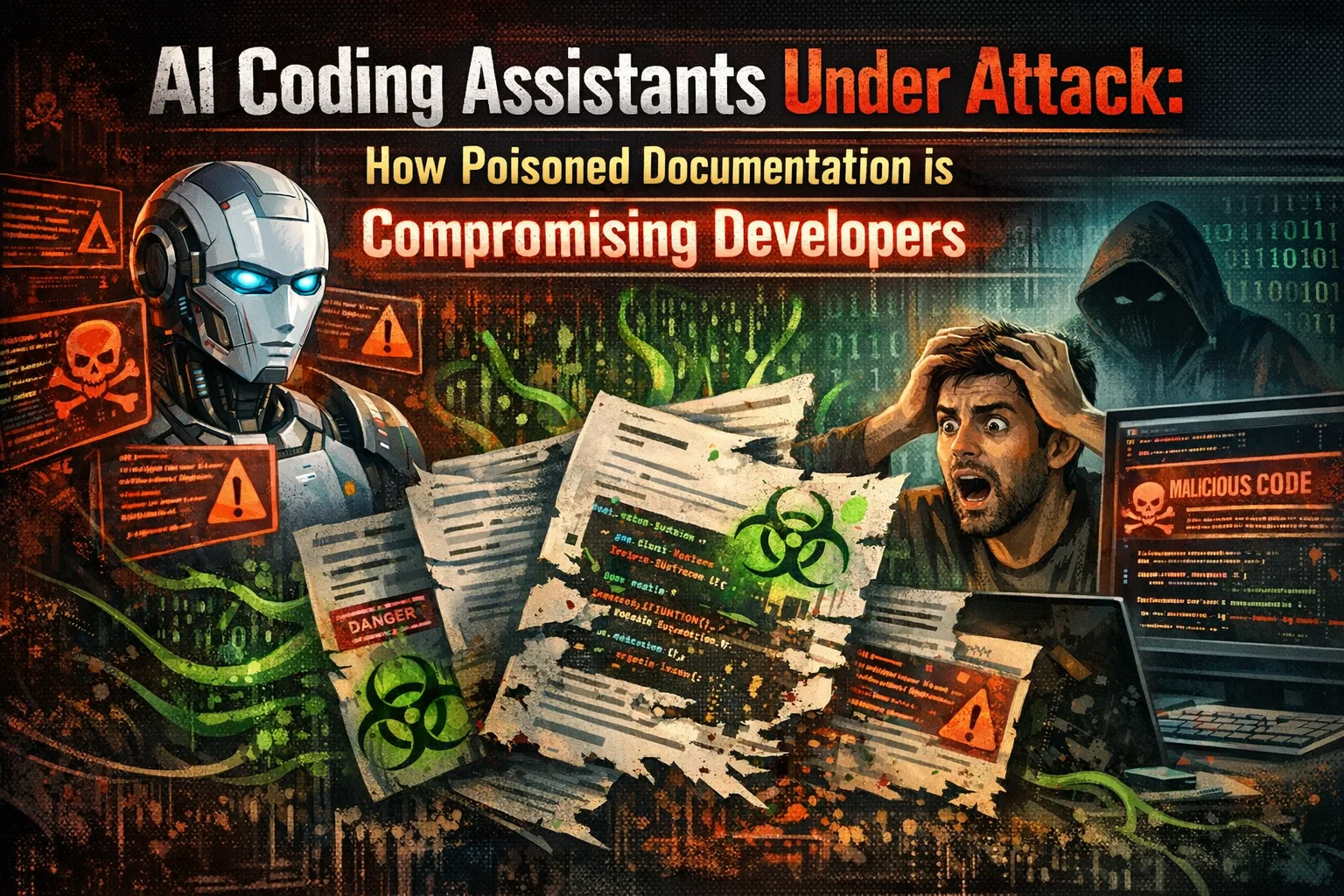
A new and highly deceptive cyberattack is emerging—one that targets AI-powered coding assistants like GitHub Copilot. Instead of exploiting software vulnerabilities or injecting malicious code into repositories, attackers are taking a far subtler route: poisoning technical documentation.
By publishing misleading or manipulated content online, hackers can trick large language models (LLMs) into recommending malicious libraries—turning trusted AI tools into unwitting accomplices.
The Rise of “Documentation Poisoning”
The concept is surprisingly simple—and dangerously effective.
Rather than attacking code directly, threat actors:
- Publish fake or misleading documentation
- Embed references to malicious packages
- Distribute this content across forums, wikis, and public repositories
Once this data is scraped or used in training, LLMs begin to treat it as legitimate knowledge.
When developers later ask for help, the AI may confidently suggest compromised libraries—without any obvious red flags.
Indirect Prompt Injection Explained
This technique is known as indirect prompt injection, a growing concern in the field of cybersecurity.
Here’s how it works:
- An attacker creates technical content describing a solution
- The solution includes a malicious dependency disguised as legitimate
- The content is indexed or learned by AI models
- The AI later recommends that dependency in generated code
Because developers often trust AI suggestions, they may install the package without verifying its authenticity—compromising their systems instantly.
Typosquatting Enters a New Era
This attack method takes typosquatting to the next level.
Traditionally, typosquatting relied on human error—developers accidentally typing the wrong package name. Now, the AI makes the mistake for them.
Influenced by poisoned sources, AI tools can:
- Suggest slightly altered package names
- Recommend malicious alternatives that appear legitimate
Worse, these suggestions are delivered with confidence and clarity, making them harder to question. The result? Developers unknowingly execute harmful code generated by tools they trust.
Why Traditional Security Tools Fail
One of the most alarming aspects of this attack is its invisibility to conventional defenses.
Most security tools are designed to:
- Scan source code
- Detect known vulnerabilities
- Flag suspicious behavior
But this threat operates entirely in natural language, not code.
That means:
- No malicious code is present initially
- No alerts are triggered during scanning
- The attack only materializes when the AI-generated suggestion is executed
This creates a blind spot in modern software security practices.
A Growing Risk to the Software Supply Chain
This new attack vector exposes a deeper issue: the trust placed in AI-generated recommendations.
As AI tools become central to development workflows, they also become part of the software supply chain. If their outputs are compromised, the entire chain is at risk.
The problem is not just human error anymore—it’s machine-influenced decision-making.
What Developers and Teams Should Do
To mitigate this risk, developers must adopt stricter verification practices:
- ✅ Always verify third-party packages before installing
- ✅ Cross-check documentation with official sources
- ✅ Avoid blindly trusting AI-generated code
- ✅ Use dependency scanning and reputation tools
- ✅ Monitor unusual package behavior after installation
Organizations may also need to implement documentation trust scoring systems in the future to validate sources used by AI.
Conclusion: When AI Becomes the Weak Link
This emerging threat highlights a critical shift in cybersecurity. The weakest link is no longer just the developer—it’s the AI assistant guiding them.
As tools like GitHub Copilot continue to evolve, so do the tactics used to exploit them. Documentation poisoning and indirect prompt injection represent a new class of attacks—subtle, scalable, and difficult to detect.
The takeaway is clear: AI can accelerate development, but it cannot replace critical thinking. Trust, but verify—especially when the suggestion comes from a machine.
And if you'd like to go a step further in supporting us, you can treat us to a virtual coffee ☕️. Thank you for your support ❤️!

We do not support or promote any form of piracy, copyright infringement, or illegal use of software, video content, or digital resources.
Any mention of third-party sites, tools, or platforms is purely for informational purposes. It is the responsibility of each reader to comply with the laws in their country, as well as the terms of use of the services mentioned.
We strongly encourage the use of legal, open-source, or official solutions in a responsible manner.
Comments