

After months of leaks, regulatory filings, and even an accidental reveal from ASRock, AMD has officially unveiled the Ryzen 9 9950X3D2 Dual Edition—and it’s a major milestone in desktop CPU design.
This new processor is the first consumer desktop chip to feature dual 3D V-Cache chiplets, marking a significant leap forward in performance architecture. Built for gamers, developers, and content creators, it aims to deliver top-tier power across both gaming and demanding workloads.
Set to launch on April 22, 2026, here’s everything you need to know.
A Fully Symmetrical X3D Architecture
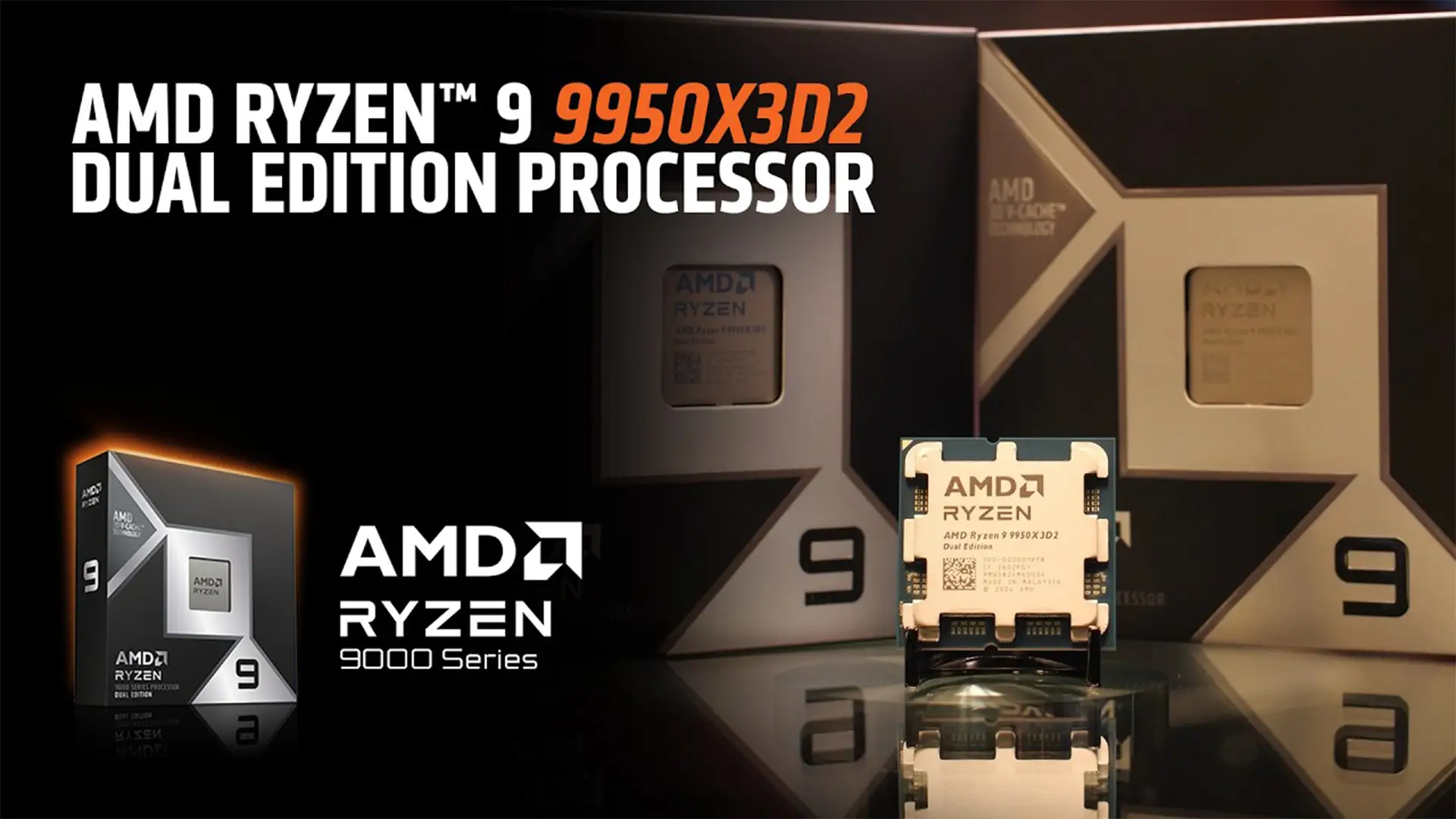
Until now, AMD’s high-end X3D processors—including the Ryzen 9 9950X3D—featured 3D V-Cache on only one chiplet (CCD). While effective, this design created an imbalance, with performance varying depending on which cores were being used.
With the Ryzen 9 9950X3D2 Dual Edition, AMD has solved this limitation by equipping both chiplets with second-generation 3D V-Cache.
What does this mean?
- Each chiplet now includes 104 MB of cache
- Total cache reaches a massive 208 MB
- This is the largest cache ever seen on a Ryzen desktop CPU
The result is a more consistent and predictable performance profile, especially in workloads that rely heavily on cache efficiency.
Core Specifications
Despite the cache upgrade, the core architecture remains familiar:
- Architecture: Zen 5
- Socket: AM5
- Cores / Threads: 16 cores / 32 threads
- Boost Clock: Up to 5.6 GHz
- Total Cache: 208 MB
- TDP: 200W (up from 170W on the previous model)
The higher TDP reflects the increased power required to fully leverage the dual 3D V-Cache setup.
Performance Gains Beyond Gaming
While X3D chips are often associated with gaming, AMD is positioning the 9950X3D2 as a hybrid powerhouse—equally capable in professional workloads.
Notable performance improvements (vs. 9950X3D):
- +7% in rendering tools like Blender and V-Ray
- +7% in video editing benchmarks such as DaVinci Resolve
- +5% in multi-core tests like Geekbench
- Up to +13% in data science workloads (SPEC Workstation)
- Measurable gains in code compilation using Unreal Engine and Chromium
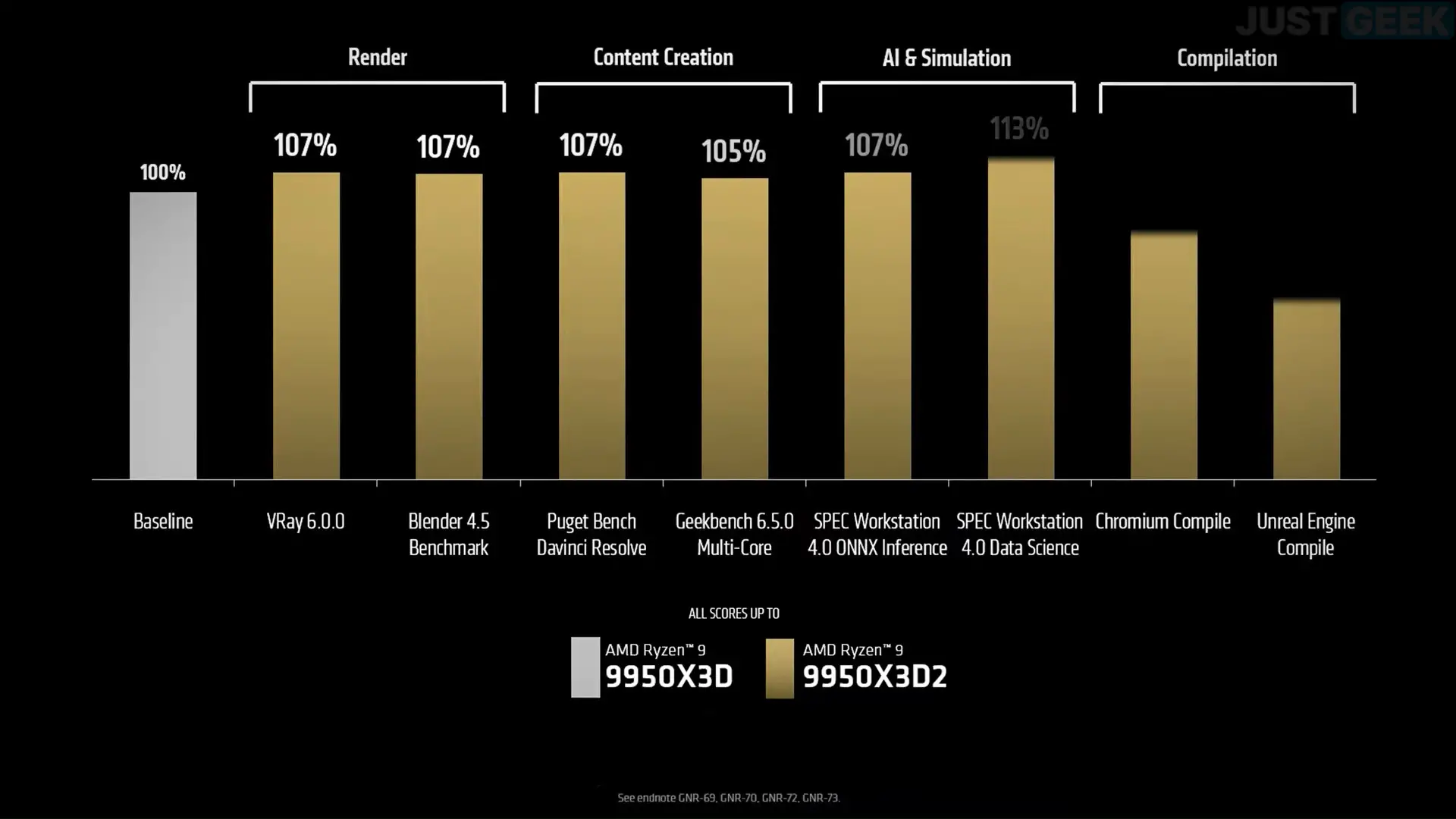
These improvements highlight the advantage of larger and evenly distributed cache, especially in:
- Rendering
- Simulation
- AI inference
- Large-scale code compilation
That said, as with all manufacturer benchmarks, independent testing will be crucial to validate these claims in real-world scenarios.
Who Is This CPU For?
The Ryzen 9 9950X3D2 Dual Edition targets users who need both gaming performance and heavy multitasking capabilities, including:
- High-end PC gamers
- Video editors and 3D artists
- Software developers
- Data scientists and AI workloads
It’s designed for people who don’t want to compromise between gaming and productivity.
Release Date and Expected Price
- Release Date: April 22, 2026
- Official Price: Not yet announced
For reference, the standard 9950X3D currently sells for around €700 (~$750 USD). Given the upgraded architecture and higher power envelope, the Dual Edition is expected to launch at a premium price point.
Whether AMD positions it as a mainstream flagship or a niche enthusiast product remains to be seen.
Final Thoughts
The Ryzen 9 9950X3D2 Dual Edition represents a significant evolution in CPU design. By introducing a fully symmetrical dual 3D V-Cache architecture, AMD is addressing one of the biggest limitations of previous X3D chips.
If real-world benchmarks confirm the promised gains, this processor could become:
- One of the best CPUs for gaming and content creation
- A new benchmark for hybrid performance workloads
For now, all eyes are on independent reviews—but one thing is clear: AMD is pushing desktop CPUs into a new era of performance.
And if you'd like to go a step further in supporting us, you can treat us to a virtual coffee ☕️. Thank you for your support ❤️!

We do not support or promote any form of piracy, copyright infringement, or illegal use of software, video content, or digital resources.
Any mention of third-party sites, tools, or platforms is purely for informational purposes. It is the responsibility of each reader to comply with the laws in their country, as well as the terms of use of the services mentioned.
We strongly encourage the use of legal, open-source, or official solutions in a responsible manner.
Comments