

The flagship smartphone chip battle is getting more interesting. Apple introduced the A20 Pro with the iPhone 18 Pro lineup, while Qualcomm’s Snapdragon 8 Elite Gen 5 is already powering a new generation of Android flagships.
Both processors sit at the top of their respective platforms, but they take very different approaches to performance, efficiency, AI, and graphics.
Apple has the advantage of designing the A20 Pro specifically for its own iPhones and operating system. Qualcomm, meanwhile, builds the Snapdragon 8 Elite Gen 5 as a platform that can power smartphones from numerous manufacturers.
So which chip is actually faster?
The early benchmark results give Apple an advantage in CPU performance, while Qualcomm’s latest Adreno GPU remains extremely competitive for gaming. However, raw benchmark scores don’t tell the entire story.
Here’s how the A20 Pro vs Snapdragon 8 Elite Gen 5 comparison looks across CPU performance, graphics, AI, efficiency, memory, and real-world availability.
A20 Pro vs Snapdragon 8 Elite Gen 5: Specs Compared
| Specification | Apple A20 Pro | Snapdragon 8 Elite Gen 5 |
|---|---|---|
| Manufacturing process | TSMC 2nm | TSMC 3nm (N3P) |
| CPU | 6-core CPU | 8-core 3rd-gen Oryon CPU |
| CPU configuration | 2 performance + 4 efficiency cores | 2 prime + 6 performance cores |
| Peak clock speed | Around 4.93GHz* | Up to 4.6GHz |
| GPU | 7-core Apple GPU | Adreno GPU |
| Geekbench 6 single-core | ~4,720–4,770* | ~3,588 |
| Geekbench 6 multi-core | ~12,575–12,990* | ~10,207 |
| AI processor | 32-core Neural Engine | Hexagon NPU |
| Memory | New Apple memory architecture | LPDDR5X up to 5.3GHz |
| Announced | September 9, 2026 | September 24, 2025 |
*Early or reported figures rather than Apple-confirmed benchmark results.
These numbers should be treated as directional rather than definitive. The processors are not being tested inside identical phones under identical thermal conditions, software versions, or power limits.
A20 Pro vs Snapdragon 8 Elite Gen 5: Why the 2nm Process Matters
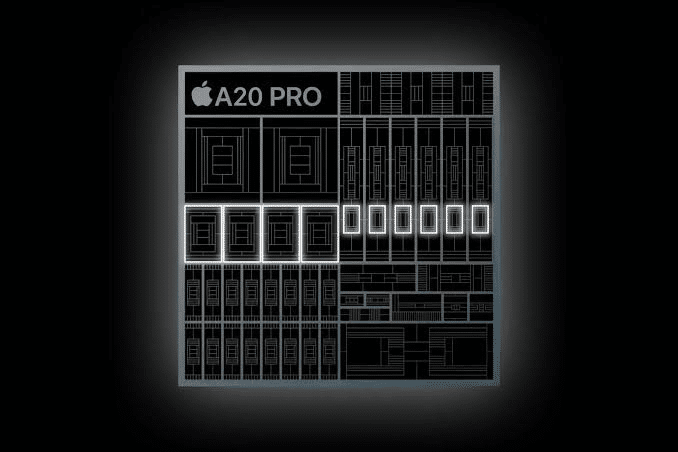
One of the biggest differences between the two chips is the manufacturing process.
The A20 Pro is Apple’s first 2nm smartphone chip, while the Snapdragon 8 Elite Gen 5 is manufactured using TSMC’s 3nm N3P process.
A smaller manufacturing node generally allows chip designers to fit more transistors into a given area while improving efficiency. That doesn’t automatically make a processor faster, but it gives Apple more room to increase performance without proportionally increasing power consumption.
Apple says the A20 Pro benefits from significantly higher transistor density compared with its predecessor. The company also redesigned the iPhone 18 Pro’s thermal architecture to help the processor maintain performance during demanding workloads.
Qualcomm has made major efficiency improvements of its own. The company claims the Snapdragon 8 Elite Gen 5 delivers a 35% improvement in CPU power efficiency compared with its predecessor, along with improvements in overall system efficiency.

The difference is therefore less about Qualcomm ignoring efficiency and more about the two companies using different ways to achieve it.
Apple has the advantage of a newer manufacturing process, while Qualcomm has optimized a platform that needs to work across a much broader range of Android hardware.
CPU Performance: A20 Pro Takes the Lead

CPU performance is where the A20 Pro appears to have its clearest advantage.
Early Geekbench 6 results for the iPhone 18 Pro and iPhone 18 Pro Max put the A20 Pro in the neighborhood of 4,720 to 4,770 points in single-core testing, with multi-core results around 12,575 to 12,990.
The Snapdragon 8 Elite Gen 5, meanwhile, produces reported results closer to 3,588 single-core and 10,207 multi-core in Geekbench 6.
If these results hold across retail devices and broader testing, Apple’s chip has a substantial CPU advantage.
Geekbench 6 Performance
| Benchmark | A20 Pro | Snapdragon 8 Elite Gen 5 | Apparent advantage |
|---|---|---|---|
| Single-core | ~4,720–4,770 | ~3,588 | A20 Pro |
| Multi-core | ~12,575–12,990 | ~10,207 | A20 Pro |
The architecture helps explain some of the difference.
Apple uses a six-core CPU with two high-performance cores and four efficiency cores. Qualcomm’s third-generation Oryon design uses eight cores, including two prime cores and six performance cores.
Apple’s approach prioritizes extremely high single-thread performance, while Qualcomm has more performance cores available for heavily parallel workloads.
For everyday tasks such as opening apps, navigating the interface, processing photographs, and many browser workloads, Apple’s single-core advantage can be particularly useful.
For sustained multi-threaded workloads, however, the number of cores is only one part of the equation. Cooling, power limits, software optimization, and the specific phone also matter.
A20 Pro vs Snapdragon 8 Elite Gen 5 for Gaming

Gaming makes the comparison considerably more complicated.
The A20 Pro features a 7-core Apple GPU, with Apple claiming a substantial graphics performance improvement over the previous generation.
Qualcomm’s Snapdragon 8 Elite Gen 5 uses a new-generation Adreno GPU, with Qualcomm claiming improvements in both graphics performance and ray tracing compared with the previous Snapdragon generation.

The Snapdragon platform also has an important advantage: it is designed for a much broader Android gaming ecosystem.
Developers have to optimize games across many different Android phones, GPUs, thermal systems, and display configurations. Apple has a much smaller hardware ecosystem, allowing developers to target a relatively predictable set of GPU architectures.
Peak Performance Isn’t the Whole Story
Short benchmark runs can make one processor look significantly faster than another.
Long gaming sessions are different.
As temperatures rise, smartphones may reduce CPU and GPU frequencies to control heat and power consumption. This is why a chip that wins a three-minute benchmark isn’t necessarily the chip that delivers the best performance after 30 or 45 minutes of gaming.
The phone’s cooling system therefore matters almost as much as the processor itself.
For buyers interested primarily in gaming, don’t judge the A20 Pro vs Snapdragon 8 Elite Gen 5 comparison by the chipset name alone. The specific phone’s cooling system, display resolution, battery capacity, game optimization, and sustained performance are equally important.
Neural Engine vs Hexagon NPU: Which Is Better for AI?
AI is another major battleground.
Apple expanded the A20 Pro’s Neural Engine to 32 cores, using two 16-core blocks. Apple says the new design delivers significantly more AI processing capability than the previous generation.
The goal is increasingly clear: run more AI workloads directly on the iPhone instead of constantly sending information to cloud servers.
Qualcomm takes a similar approach with its Hexagon NPU, which handles AI workloads alongside the rest of the Snapdragon platform.
The Snapdragon 8 Elite Gen 5 also combines its NPU with other components designed for on-device and context-aware AI features.
Apple vs Qualcomm AI Strategy
The difference is largely in how each company integrates AI into its ecosystem.
Apple controls:
- The A20 Pro
- iOS
- Apple Intelligence
- The iPhone hardware
- The Neural Engine
- The developer APIs
Qualcomm provides:
- The Snapdragon CPU
- Adreno GPU
- Hexagon NPU
- Connectivity
- AI software tools
Qualcomm’s platform therefore needs to accommodate many different Android manufacturers and software implementations.
That makes direct AI benchmark comparisons difficult. A faster NPU doesn’t necessarily mean a phone delivers better AI features if the software isn’t taking advantage of the hardware.
For consumers, the important question isn’t simply which NPU has more theoretical performance. It’s which phone actually provides the AI features they want.
Memory and Connectivity
The A20 Pro also benefits from changes to Apple’s memory architecture and system-level integration.
Apple has focused on improving memory bandwidth and thermal behavior, helping the processor feed its CPU and GPU more efficiently during demanding workloads.
The Snapdragon 8 Elite Gen 5 supports LPDDR5X memory running at up to 5.3GHz, alongside modern UFS storage.
Connectivity is similarly advanced on both platforms.
The Snapdragon platform supports technologies such as:
- Wi-Fi 7
- Bluetooth 6
- 5G connectivity
- Qualcomm’s Snapdragon modem platform
- High-speed LPDDR5X memory
- UFS 4.1 storage
Apple’s A20 Pro platform is paired with Apple’s newer wireless and modem components, including support for Wi-Fi 7, Bluetooth 6, Thread, and the company’s newer C2 modem.
In other words, neither chip is lacking modern connectivity features. The differences become more significant when looking at how each manufacturer integrates those components into its phone.
Which Phones Use the A20 Pro?
The A20 Pro is exclusive to Apple’s high-end iPhone 18 Pro family.
That means buyers looking for Apple’s fastest mobile processor have a straightforward choice:
- iPhone 18 Pro
- iPhone 18 Pro Max
This is one of Apple’s biggest advantages and disadvantages at the same time.
Apple can optimize the A20 Pro specifically for a small number of iPhones, but consumers don’t have the option of buying an A20 Pro phone from another manufacturer.
Which Phones Use Snapdragon 8 Elite Gen 5?
Qualcomm takes the opposite approach.
The Snapdragon 8 Elite Gen 5 is designed to appear in flagship Android phones from multiple manufacturers.
Examples include devices from brands such as:
- OnePlus
- Xiaomi
- Samsung in selected markets
- Other major Android manufacturers
One important exception is Samsung’s Galaxy lineup.
Samsung can use different processors depending on the market, meaning the same Galaxy model name doesn’t necessarily guarantee that every region gets the Snapdragon version.
That’s something buyers should check before purchasing an imported or international phone.
A20 Pro vs Snapdragon 8 Elite Gen 5: Which Is Better?
Based on the early performance numbers, the A20 Pro has the CPU advantage.
Its combination of high single-core performance, strong multi-core results, Apple’s tight hardware-software integration, and the move to a 2nm manufacturing process makes it an extremely powerful smartphone processor.
The Snapdragon 8 Elite Gen 5 isn’t far behind, though. Its Oryon CPU architecture, Adreno GPU, Hexagon NPU, and broad Android availability make it one of the most capable mobile platforms available.
Here’s the simplest breakdown:
| Category | Winner |
|---|---|
| CPU single-core | A20 Pro |
| CPU multi-core | A20 Pro |
| Manufacturing process | A20 Pro |
| Hardware/software integration | A20 Pro |
| Android availability | Snapdragon 8 Elite Gen 5 |
| Device variety | Snapdragon 8 Elite Gen 5 |
| Gaming potential | Very close |
| On-device AI | Too close to call universally |
| Connectivity | Both excellent |
| Choice of phones | Snapdragon 8 Elite Gen 5 |
Final Verdict
If we’re judging strictly by the early benchmark numbers and underlying technology, the A20 Pro comes out ahead of the Snapdragon 8 Elite Gen 5.
Apple’s move to 2nm gives the A20 Pro an important manufacturing advantage, while its CPU architecture delivers particularly strong single-core performance. Apple’s control over both the processor and iOS also allows it to optimize the entire experience around a relatively small number of devices.
But Qualcomm’s Snapdragon 8 Elite Gen 5 has a different kind of advantage.
You can find it across a much wider range of flagship Android smartphones, giving consumers more choices in design, cameras, displays, charging speeds, cooling systems, and prices.
So the answer isn’t simply that the A20 Pro is better.
For maximum raw CPU performance, the A20 Pro currently has the edge. For Android flexibility and hardware choice, Snapdragon 8 Elite Gen 5 is the more versatile platform.
And for most buyers, the better phone will ultimately matter more than the better chip.
Add Tech2Geek as a preferred source on Google to see more of our latest tech articles.
Support Tech2Geek ❤️
Did this guide help you? If Tech2Geek saves you time or helps you solve a problem,
consider buying me a coffee. ☕
Your support helps keep Tech2Geek independent and free.
Comments