
What happens when you change the system instructions that govern an AI model? Depending on the model and the instructions involved, you can influence its persona, response style, operating rules, and how it handles conflicting instructions.
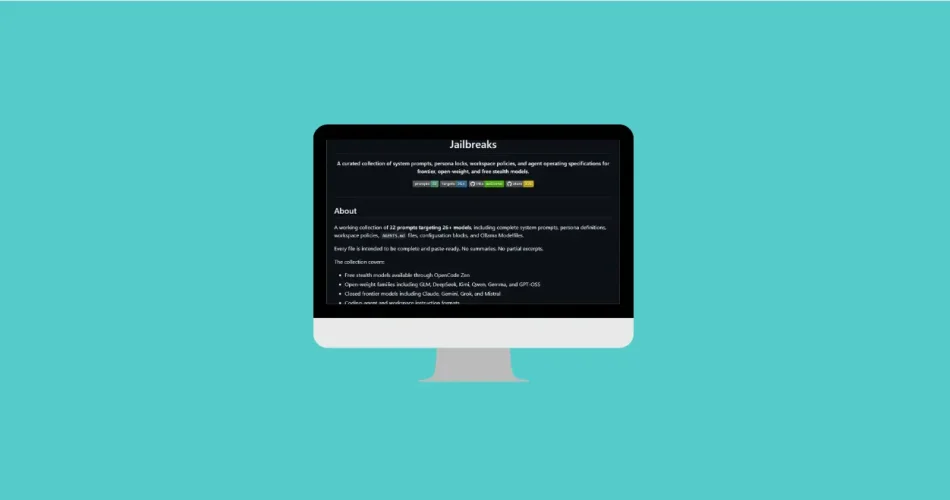
A GitHub project called Jailbreaks explores this area by collecting system prompts, persona definitions, workspace policies, and agent configurations for a wide range of AI models.
Rather than providing short prompt examples, the repository aims to offer complete, ready-to-use configuration files that developers and researchers can examine, test, and adapt.
What Is the Jailbreaks GitHub Repository?
Jailbreaks is a curated collection of 32 prompt files targeting more than 26 AI models. It includes configurations for closed-source frontier models, open-weight language models, and coding agents.
The collection covers several types of instruction files, including:
- Complete system prompts
- AI persona definitions
- Assistant operating specifications
- Workspace policies
AGENTS.mdinstruction files- Ollama Modelfiles
- Harness-specific configuration blocks
The project’s main goal is to document how different instruction strategies affect AI behavior. Each file is designed to be complete and ready to paste into a compatible configuration field, rather than presenting a shortened explanation or partial excerpt.
Which AI Models Are Supported?
The repository covers models from several major AI developers, including Anthropic, Google, DeepSeek, Moonshot, xAI, Zhipu, Alibaba, NVIDIA, and Mistral.
Here is an overview of the available configurations.
Warning
Research and educational purposes only.
This repository documents how instruction hierarchies, persona framing, prompt conflicts, and policy overrides can affect model behavior. These techniques are also useful to researchers and developers studying how to make AI systems more resistant to prompt injection and instruction manipulation.
Do not use this material to harm others, bypass applicable laws, or violate the terms of service of a platform or model provider.
OpenCode Zen: Free Stealth Models
One section focuses on models available through OpenCode Zen.
| Model | Configuration file | Type |
|---|---|---|
| Big Pickle | BigPickle-opencode.md | VANTA persona lock |
| Space Bunny | spacebunny-agents.md | Assistant operating specification |
| LongCat 2.5 | longcat-agents.md | Assistant operating specification |
| MiMo V2.6 | mimo-2.6-agents.md | Assistant operating specification |
| Step 5 Preview | Step-5-preview.md | Workspace operating profile |
| Muse Spark 1.3 | Muse spark 1.3.md | Agent deployment policy |
| Muse Spark 1.3 v2 | Muse-spark-1-3-v2.md | Runtime scope-note variant |
| Muse.ai | muse-ai-AGENTS.md | Assistant operating specification |
Anthropic: Claude
Claude configurations include different versions of prompts for Opus and Sonnet.
| Model | Configuration files | Type |
|---|---|---|
| Claude Opus | opus v1.md, opus v2.md | Conversational persona |
| Claude Sonnet | sonnet v1.md, Sonnet v2.md | Writer’s-room framing |
These files explore different ways of defining an assistant’s conversational behavior and working style.
Zhipu: GLM and ZCode
The repository also includes several configurations for Zhipu’s GLM family.
| Model | Configuration files | Type |
|---|---|---|
| GLM-5.2 | glm-5.2.md | System prompt |
| GLM ZCode 5.2 | glm-zcode-5.2.md | System prompt |
| GLM ZCode 5.3 | glm-zcode-5.3.md, glm-zcode-5.3-AGENTS.md | System prompt and AGENTS.md |
| GLM-5.3 Flash | glm-5-3-flash.md | Assistant operating specification |
| GLM-5.3 (OpenCode) | glm5-3opencode.md | Assistant operating specification |
DeepSeek
For DeepSeek models, the collection provides configurations for multiple generations.
| Model | Configuration file | Type |
|---|---|---|
| DeepSeek V3 | deepseek v3.md | System prompt |
| DeepSeek V4 | deepseek v4.md | System prompt |
| DeepSeek 4.1 | deepseek-4-1.md | Assistant operating specification |
Moonshot: Kimi
Kimi users can explore the following files:
| Model | Configuration file | Type |
|---|---|---|
| Kimi K2 | kimi-k2.md | System prompt |
| Kimi K3 | kimi-k3-agents.md | Workspace operating profile |
xAI: Grok
The Grok section contains both agent instructions and configuration examples.
| Model | Configuration file | Type |
|---|---|---|
| Grok Build | Grok build.md | Agent operating instructions |
| Grok 4.7 | grok-4.7.md | App-builder workspace guide |
| Grok Config | grok-config.txt | Priority and routing configuration |
NVIDIA: Nemotron
The repository includes an assistant operating specification for:
- Nemotron 3 Ultra 550B A55B:
nemotron-3-ultra.md
Google, Mistral, and Alibaba
Other supported models include:
| Model | Configuration file | Type |
|---|---|---|
| Gemini 4 Argon | Gemini-4-Argon.md | Operating policy |
| Gemini 3.1 Pro | Gemini-3.1-Pro.md | System prompt |
| Mistral Large 4 | Mistral-Large-4.md | Agent system prompt |
| Qwen 3.7 | qwen-3.7.md | System prompt |
| Qwen 3.8 | qwen-3.8.md | System prompt |
Ollama Modelfiles
Local AI enthusiasts using Ollama can also find ready-to-use Modelfile examples.
| Model | File | Configuration |
|---|---|---|
| Gemma 4 | gemma4.md | FROM and SYSTEM blocks |
| GPT-OSS 20B | gpt-oss-20b.md | FROM and SYSTEM blocks |
How to Use the Prompt Files
The repository supports several configuration formats. The correct installation method depends on the AI client, model runtime, or coding-agent environment you are using.
1. Configure a System Prompt
For models and applications that support custom system instructions, copy the contents of the relevant file into the appropriate configuration field.
Common destinations include:
- API system messages
- Chatbot custom-instruction settings
- Agent-level instruction blocks
- Harness-specific system prompt configurations
Make sure you select a prompt intended for the model and environment you are actually using.
2. Use AGENTS.md With Coding Agents
Some coding agents support AGENTS.md files as project-level instructions.
To use one, save the relevant configuration as:
AGENTS.md
Then place it in the root directory of your project or workspace. Compatible coding agents can use these instructions to guide their behavior while working on that codebase.
3. Configure Workspace Policies
Files described as assistant operating specifications or workspace operating profiles are intended for environments that support persistent instructions.
For example, OpenCode users may place a configuration file at:
~/.config/opencode/AGENTS.md
The exact location can vary depending on the client and its configuration.
4. Create an Ollama Model
Ollama users can create a customized model using one of the supplied Modelfiles.
For example, to create a model based on the Gemma 4 configuration, run:
ollama create gemma4-jb -f gemma4.mdYou can change the model name and source file to match your configuration.
5. Apply Grok Configuration Files
Files specifically designed for Grok should be placed in the configuration field supported by the target application or harness.
They are not necessarily intended to be pasted into an ordinary conversation as a regular user message.
Important: Prompt Compatibility Can Change
One important limitation is that system-prompt behavior is highly dependent on model versions and the environment in which they run.
AI providers regularly update their models, change instruction hierarchies, and modify how system-level and user-level instructions interact.
As a result, a configuration that works with one release may behave differently or stop working after an update.
If you find an outdated or nonfunctional prompt, the repository encourages users to open an issue or submit a pull request. Including the model name, exact version, and affected configuration file makes it easier for maintainers to investigate.
How to Contribute to the Collection
The project welcomes contributions from developers and AI researchers.
To keep the repository organized, contributors are encouraged to follow a few conventions:
- One prompt per file: Keep each configuration separate.
- Use descriptive filenames: Prefer lowercase names with hyphens, such as
model-name.md. - Include complete instructions: Submit ready-to-use prompts rather than summaries or partial excerpts.
- Document the intended environment: Explain whether the file belongs in a system prompt,
AGENTS.md, an Ollama Modelfile, or another configuration field. - Track major revisions: Use separate versioned files, such as
opus-v3.md, instead of silently replacing an existing prompt. - Avoid unverified compatibility claims: Only document model versions and environments that have actually been tested.
If a prompt no longer behaves as expected, even a detailed bug report can help improve the collection.
Is the Jailbreaks Repository Safe to Use?
The project describes itself as a research and educational resource. It explores instruction hierarchies, persona framing, prompt conflicts, and policy overrides.
These topics are relevant not only to people experimenting with AI models but also to developers working on AI security. Understanding how malicious or conflicting instructions can influence a model is an important part of building systems that are more resistant to prompt injection and instruction manipulation.
However, users should understand that these configurations do not guarantee that a model will ignore its built-in safeguards or provider policies. Their behavior depends on the model, runtime, and instruction hierarchy.
The repository also warns against using its contents to cause harm, break applicable laws, or violate platform terms of service. Users remain responsible for complying with the rules governing the AI services they use.
Final Thoughts
The Jailbreaks GitHub repository offers an extensive collection of system prompts and AI configuration files for developers who want to explore how different instruction strategies affect modern language models.
With support for Claude, Gemini, Grok, DeepSeek, GLM, Kimi, Qwen, Mistral, Ollama, and several coding-agent environments, it provides a useful starting point for AI experimentation and security research.
Whether you are customizing an AI coding assistant, testing local models, or studying prompt injection defenses, this collection brings many different configuration approaches together in one place.
You can explore the complete collection and access the individual prompt files on GitHub.
Disclaimer
All material in this repository is provided for research and educational purposes only.
The project exists to document prompt-level instruction behavior, instruction conflicts, persona framing, model configuration, and related LLM security concepts. This material may also help developers understand and harden systems against prompt injection and instruction manipulation.
The maintainers do not endorse unlawful, abusive, or harmful use of this repository.
Model providers may prohibit certain uses of these prompts under their terms of service. Users are responsible for understanding and complying with the rules, policies, and laws that apply to the systems they use.
Add Tech2Geek as a preferred source on Google to see more of our latest tech articles.
Support Tech2Geek ❤️
Did this guide help you? If Tech2Geek saves you time or helps you solve a problem,
consider buying me a coffee. ☕
Your support helps keep Tech2Geek independent and free.
Comments